

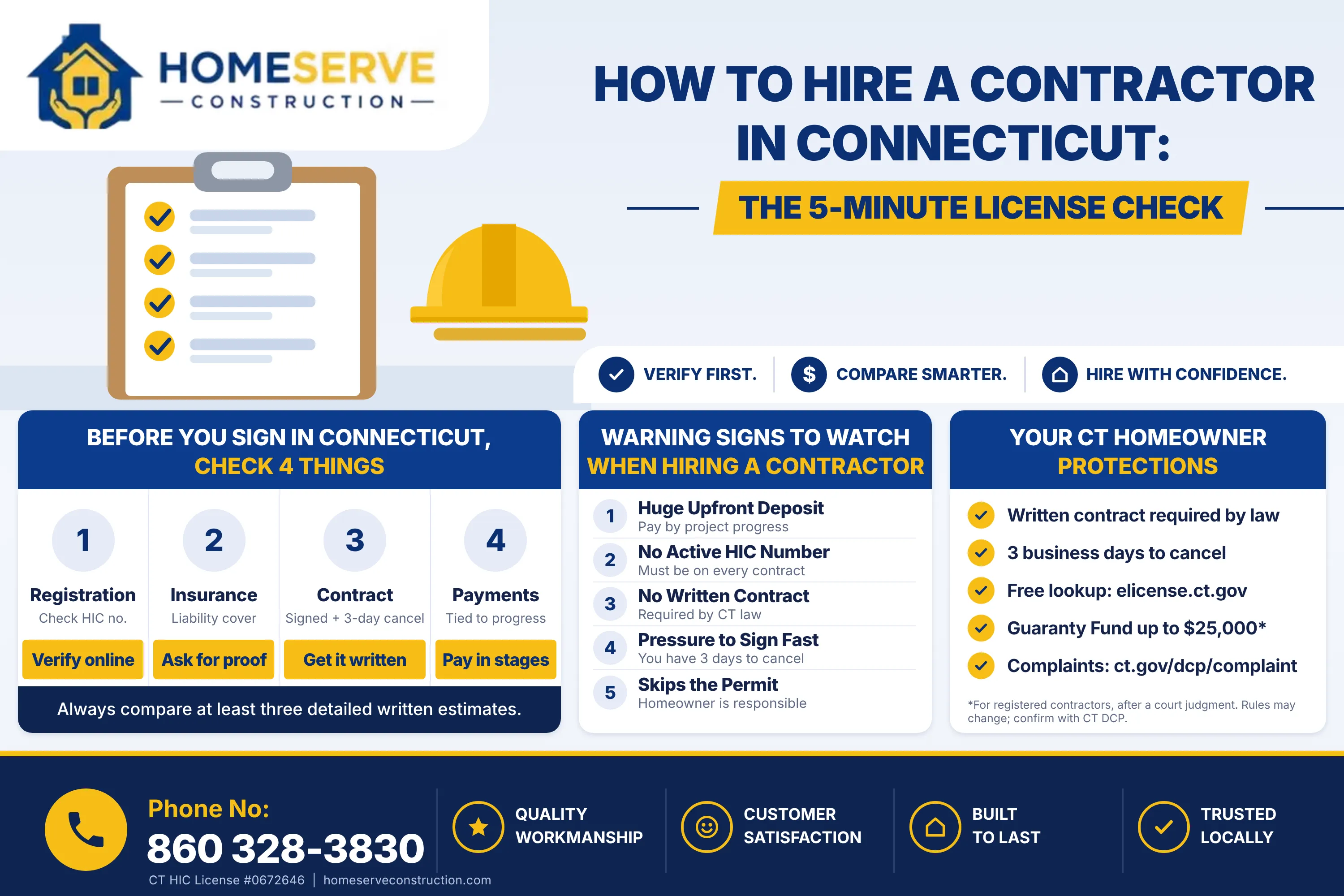
How to Hire a Contractor in Connecticut: HIC License Check, Contract Rules, and Red Flags?
Choosing a contractor is the single biggest decision in any remodel. A good one finishes on time, pulls the right permits, and leaves you with work that lasts. A bad one can take a large deposit and disappear, or leave you with unfinished work and a legal headache. Connecticut’s Department of Consumer Protection (DCP) says home improvement is one of its most common complaint areas, with 1,266 complaints received by its Investigations Division in a single recent year.
The good news is that Connecticut gives homeowners real tools to protect themselves: a state registration system you can check in two minutes, strict contract rules, and a guaranty fund. This guide walks you through how to use them, step by step.
| The short version 1. Confirm the contractor holds an active Home Improvement Contractor (HIC) registration at elicense.ct.gov. 2. Get a written, signed, dated contract that includes the HIC number and your 3-business-day right to cancel. 3. Tie payments to progress, never to a big up-front deposit. 4. Make sure the right permits are in place before work begins. |
1. How Connecticut regulates contractors
Connecticut does not issue one single “general contractor license.” Instead, it uses a registration system run by the DCP. Anyone doing home improvement work on a residence must hold a valid Home Improvement Contractor (HIC) registration, and DCP states that it is illegal to perform home improvement work with an inactive or missing registration.
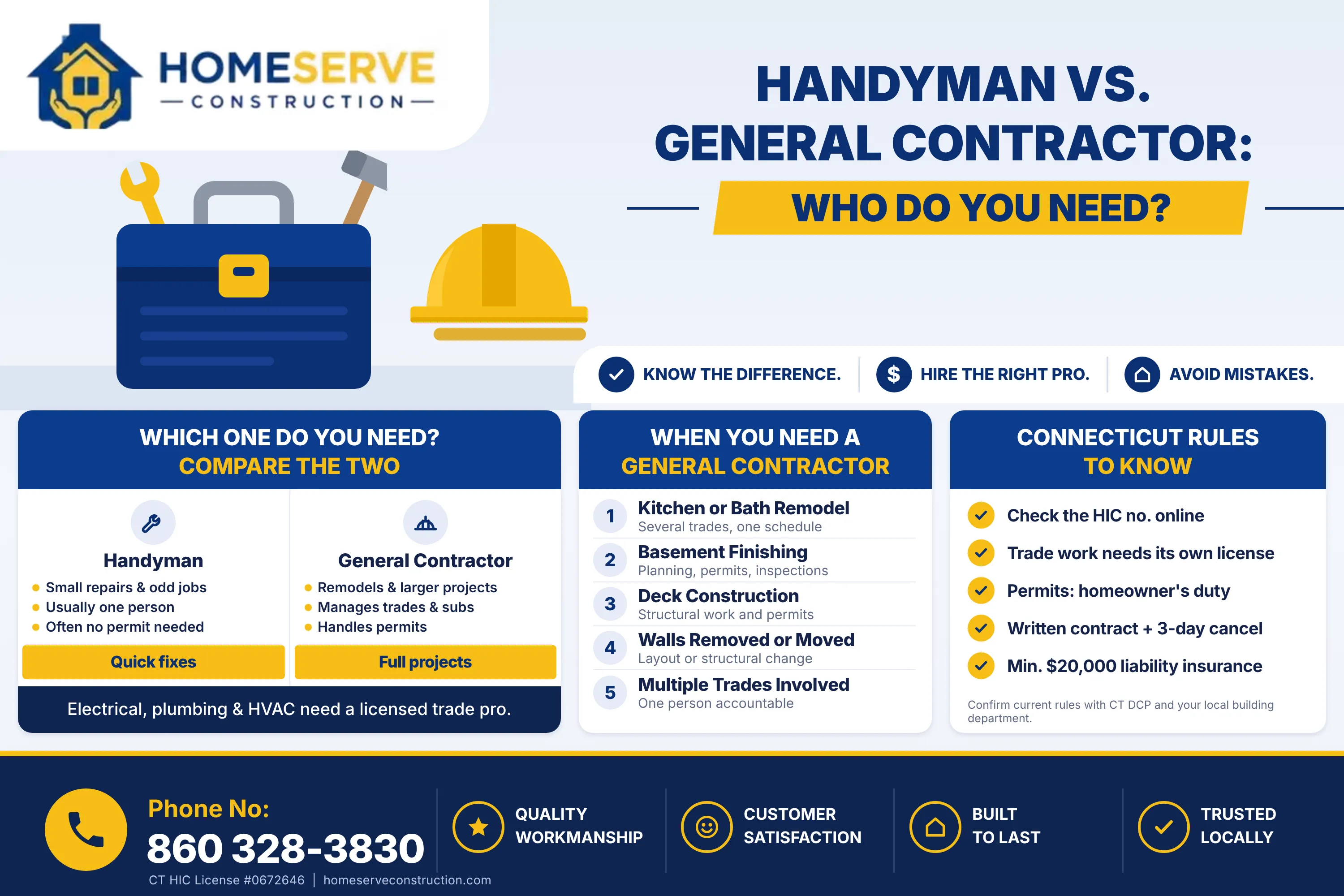
Specialty trades such as electrical, plumbing, and HVAC work are licensed separately through DCP trade licenses. So a kitchen remodel can involve a registered contractor plus licensed trade professionals under them.
Two details matter here:
- An LLC needs its own registration. DCP says a registration held by an individual does not cover the LLC. If your contract is with “ABC Remodeling LLC,” that exact business name should appear on the registration.
- Registration is not a skills test. HIC registration requires an application, a fee, and liability insurance, but no exam. Treat verification as your first filter, not proof of quality.
2. How to check a contractors HIC registration (5 minutes)
- Ask for the HIC number. A legitimate contractor will give it to you immediately, and it must appear on your contract.
- Open the state lookup. Go to elicense.ct.gov and use License Lookup (also reachable through the DCP “Verify a License” page). It is free.
- Search by number or business name. Use the exact name on the contract.
- Check the status. You want to see an active registration with a current expiration date, and a name that matches your contract.
- Check trade licenses too. If the job includes electrical, plumbing, or heating and cooling work, ask who holds those licenses and look them up the same way.
- Ask for proof of insurance. DCP requires registered contractors to carry at least $20,000 in general liability coverage. That is a minimum, so ask for a certificate that fits the size of your project. Town building departments also commonly ask for proof of workers’ compensation insurance (or a signed waiver) when a contractor pulls a permit.
| Why this matters Only homeowners who hired a registered contractor can use the state’s Home Improvement Guaranty Fund if the job goes wrong (more in section 8). An unregistered contractor can leave you with no safety net at all. |
3. What a Connecticut home improvement contract must include
Connecticut law requires a written, signed, and dated contract for every home improvement job. Do not start work on a handshake, even for a small project. At minimum, the contract must contain:
- The contractor’s name, address, and Connecticut HIC registration number
- The date you signed, and the date your cancellation right expires
- A notice of your right to cancel within three business days of signing, placed near your signature (Saturday counts as a business day in Connecticut)
- Signatures and dates from both you and the contractor, with a completed copy handed to you
- Any later changes written into the contract, with a copy to you
Beyond the legal minimum, a strong contract should also spell out the following (this is best practice, not a statutory checklist):
- A detailed scope of work, room by room or phase by phase
- Materials, brands, and model numbers for cabinets, fixtures, flooring, and finishes
- Start date and an estimated completion date
- Who handles permits and inspections
- Cleanup and debris removal, and warranty terms in writing
The three-day cancellation period is a cooling-off window. In a non-emergency, work should not begin until it has passed.
4. How to structure payments
DCP recommends a payment schedule in three or four parts that follows the progress of the work. An up-front payment to buy materials is reasonable. If a contractor asks for all or most of the money as a down payment, DCP warns this can signal financial trouble.
Here is an illustrative structure you can adapt. The exact split is for you and your contractor to agree in writing:
| Payment stage | What should trigger it |
| At signing | A modest deposit so the contractor can order materials |
| During the work | Milestones named in the contract, such as demolition complete, rough plumbing and electrical passed, cabinets installed |
| Final payment | Work finished, inspections passed, and you have walked the job and are satisfied |
How to pay: If the contractor accepts credit cards, that is the safer option. Otherwise pay by check made out to the exact name that appears on the HIC registration. Avoid cash, and avoid paying a person instead of the registered business.
Not sure what a fair price looks like? Our price guides for kitchen remodeling cost in Connecticut and bathroom remodeling cost in Connecticut will help you judge whether a bid is realistic.
5. Red flags that should make you walk away
- No HIC number, or a number that is inactive, expired, or registered under a different name
- Demands for most or all of the money up front
- Pressure to sign today or a “special price” that expires tonight
- A vague scope such as “remodel kitchen” with no materials or details
- Refusal to put changes in writing or to give you a signed copy of the contract
- Cash-only payment or a request to make the check out to an individual
- Suggesting you skip the permit or pull it under your name to avoid inspections
- Starting work before the three-day cancellation window closes, when there is no emergency
- No insurance certificate, no business address, or no local references
- A bid far below every other quote, which often means corners will be cut or extras will appear later
6. Permits: whose job is it?
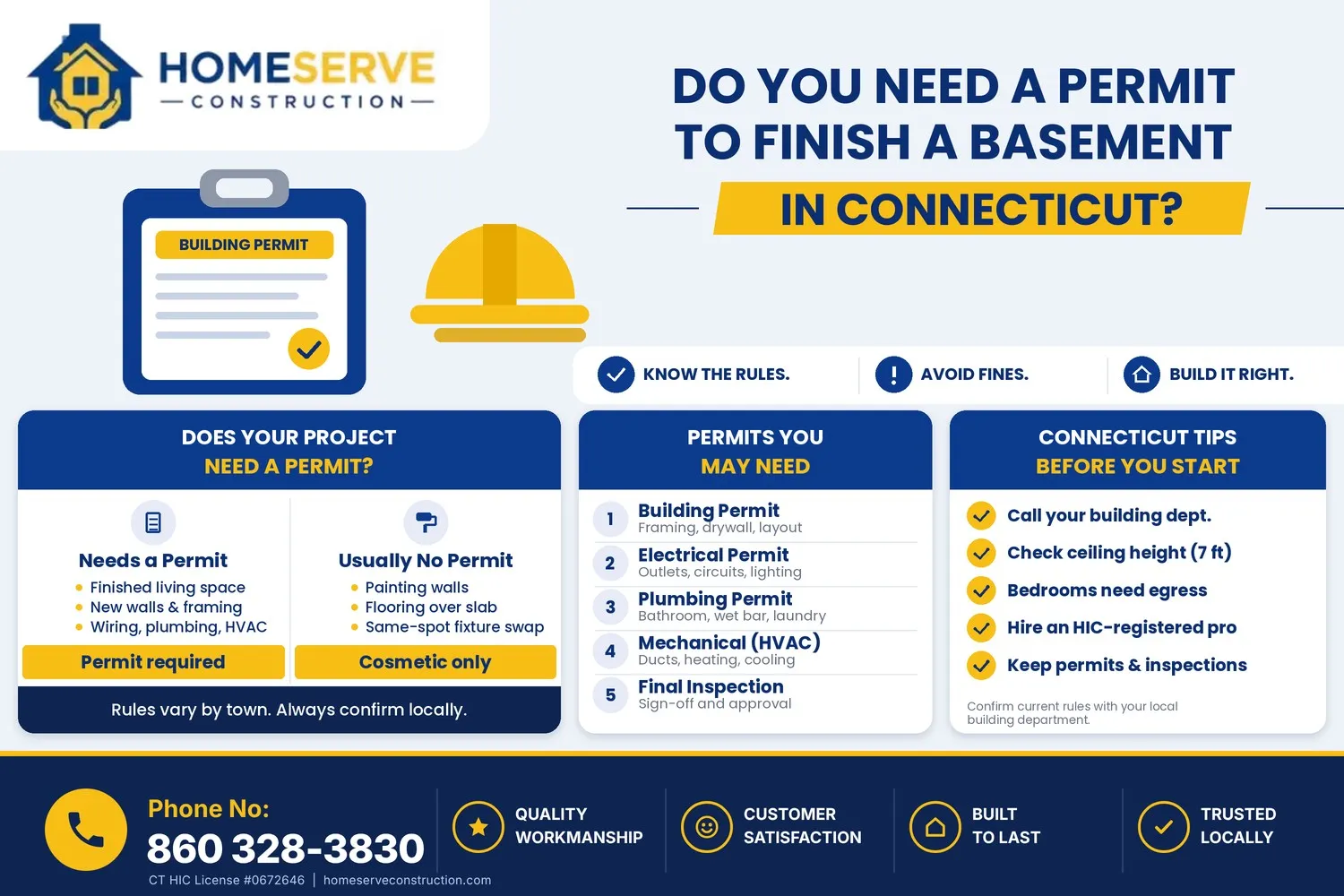
Many home improvement projects in Connecticut need a building permit from your town, and the permit must be in hand before work starts. Either you or the contractor can apply, but the state is clear that having the correct permit is ultimately the homeowner’s responsibility. If you let the contractor pull it, confirm with your local building official that everything required is in place.
Projects that involve plumbing, electrical, or heating and cooling work usually need separate trade permits as well. Skipping permits can lead to stop-work orders, fines, and problems when you sell or refinance, so a contractor who brushes the subject aside is waving a red flag.
7. Comparing bids: questions to ask
Get at least three written estimates for the same scope of work. Then ask each contractor:
- How long have you been registered, and can I see your HIC number and insurance certificate?
- Who will be on site every day, and will you use subcontractors?
- Can you give me two or three recent local projects and references I can call?
- Who pulls the permits, and who schedules inspections?
- What warranty do you offer on labor and materials, in writing?
- If my home was built before 1978, how will you handle lead-safe work practices?
Compare the quotes line by line rather than by the bottom number. A lower bid that leaves out permits, cleanup, or specific materials is rarely cheaper in the end. For budget benchmarks on other projects, see our guides to basement finishing cost in Connecticut, deck cost in Connecticut, flooring installation cost in Connecticut, and interior painting cost in Connecticut.
8. What to do if something goes wrong
- Put it in writing. Send the contractor a dated email or letter describing the problem and what you expect. Keep photos and copies of everything.
- File a complaint with DCP. You can email dcp.complaints@ct.gov or use the complaint form at ct.gov/dcp/complaint.
- Know the Guaranty Fund. If you hired a registered contractor and win a court judgment (or a court-confirmed arbitration decision) that the contractor does not pay, you may be eligible for up to $25,000 from the Home Improvement Guaranty Fund. You must apply within two years of the judgment.
Because the fund only covers registered contractors, checking the HIC registration before you sign is the cheapest protection you will ever buy.
Frequently asked questions
Does Connecticut require a general contractor license?
Not a single statewide license. Connecticut registers home improvement contractors through DCP, and electricians, plumbers, and HVAC technicians hold separate trade licenses.
How do I look up a contractor in Connecticut?
Use the free License Lookup at elicense.ct.gov. Search by HIC number or business name, then confirm the registration is active and the name matches your contract.
Can I cancel a home improvement contract in Connecticut?
Yes. You generally have three business days after signing, and Saturday counts as a business day. The contract must include a notice explaining this right. If there is a genuine emergency, a homeowner may sign a waiver.
How much deposit is reasonable?
A modest deposit to secure materials is normal. DCP recommends a payment schedule of three or four stages tied to progress, and warns that a request for all or most of the money up front can signal trouble.
What if my contractor is not registered?
Do not sign. Working without an active HIC registration is illegal in Connecticut, and an unregistered contractor leaves you without access to the Guaranty Fund.
Hire with confidence: Homeserve Construction
Homeserve Construction is a West Hartford, CT contractor handling kitchen remodeling, bathroom remodeling, basement finishing, deck construction, flooring installation, drywall installation, painting, carpentry, and handyman services. We are insured, hold CT HIC License #0672646, and we encourage every homeowner to verify our registration at elicense.ct.gov before signing anything.
See our recent work, read what customers say about us, and check the areas we serve. Planning a project? Contact us for a free, no-obligation estimate or call (860) 328-3830. We respond within 24 hours.
This guide is general information, not legal advice. Requirements can change, so confirm current rules with the Connecticut Department of Consumer Protection and your local building department.
Sources
- CT DCP: Contracting and Working With a Home Improvement Contractor – https://portal.ct.gov/dcp/trade-practices-division/contracting-and-working-with-a-home-improvement-contractor
- CT DCP: Home Improvement Contractor application and registration requirements – https://portal.ct.gov/dcp/license-services-division/all-license-applications/home-improvement-contractor-application
- CT DCP: Home Improvement Guaranty Fund – https://portal.ct.gov/DCP/Common-Elements/Consumer-Facts-and-Contacts/Home-Improvement-Guaranty-Fund
- CT DCP: Can I cancel a home improvement contract? – https://portal.ct.gov/dcp/knowledge-base/articles/consumer-topics/home-improvement/faqs/can-i-cancel-a-home-improvement-contract
- CT DCP: Consumer Protection warns homeowners planning remodeling projects – https://portal.ct.gov/dcp/news-releases-from-the-department-of-consumer-protection/2026-news-releases/consumer-protection-warns-homeowners-planning-remodeling-projects
- CT DCP: Building permits for home improvement – https://portal.ct.gov/DCP/Common-Elements/Consumer-Facts-and-Contacts/Building
- CT eLicense: License Lookup – https://www.elicense.ct.gov/Lookup/LicenseLookup.aspx