

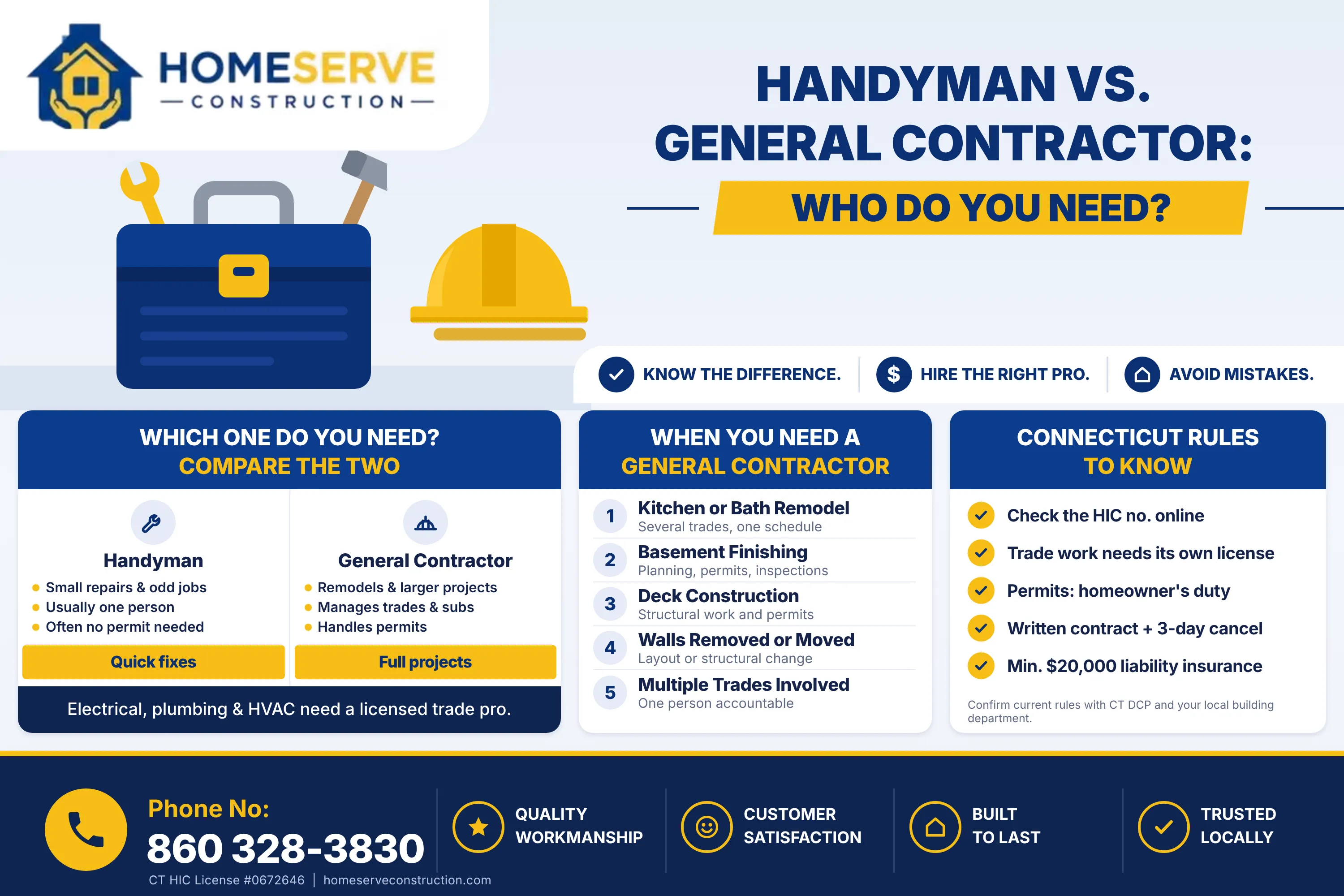
Handyman vs General Contractor: Who Do You Need for Your Connecticut Home?
You have a list: a dripping faucet, a hole in the drywall, a sticky door, and maybe a kitchen you have been dreaming of redoing. Do you call a handyman, or do you need a general contractor? Hire the wrong one and you can end up paying twice, once for work that is not done right and again to fix it.
The right choice comes down to four things: the size of the job, how many trades are involved, whether a permit is needed, and how much management the project requires. This guide explains the differences, how Connecticut regulates both, and a simple way to decide.
| The short answer Handyman: small repairs and punch-list jobs, usually one person, often no permit. General contractor: remodels and larger or multi-trade projects that need planning, permits, scheduling, and subcontractors. Either way in Connecticut: whoever does paid home improvement work at your house should hold an active Home Improvement Contractor (HIC) registration, and electrical, plumbing, and HVAC work calls for a separately licensed professional. |
1. Handyman vs general contractor at a glance
| Handyman | General contractor | |
| Typical jobs | Small repairs, installs, and odd jobs | Remodels, additions, and large or multi-step projects |
| Who does the work | Usually one person | A project manager who coordinates crews and subcontractors |
| Permits | Often not needed for cosmetic or small repairs | Plans the permits and schedules inspections for projects that need them |
| Specialty trades | Cannot do licensed trade work without the right license | Brings in licensed electricians, plumbers, and HVAC pros as subcontractors |
| Project management | You manage the task yourself | Sets the schedule, orders materials, and answers for the finished result |
| Best for | Honey-do lists and quick fixes | Kitchens, bathrooms, basements, decks, and structural changes |
2. What a handyman does best
A handyman handles small repairs and odd jobs that do not need a crew. Typical examples include:
- Furniture assembly, hanging shelves, and adjusting doors and cabinets
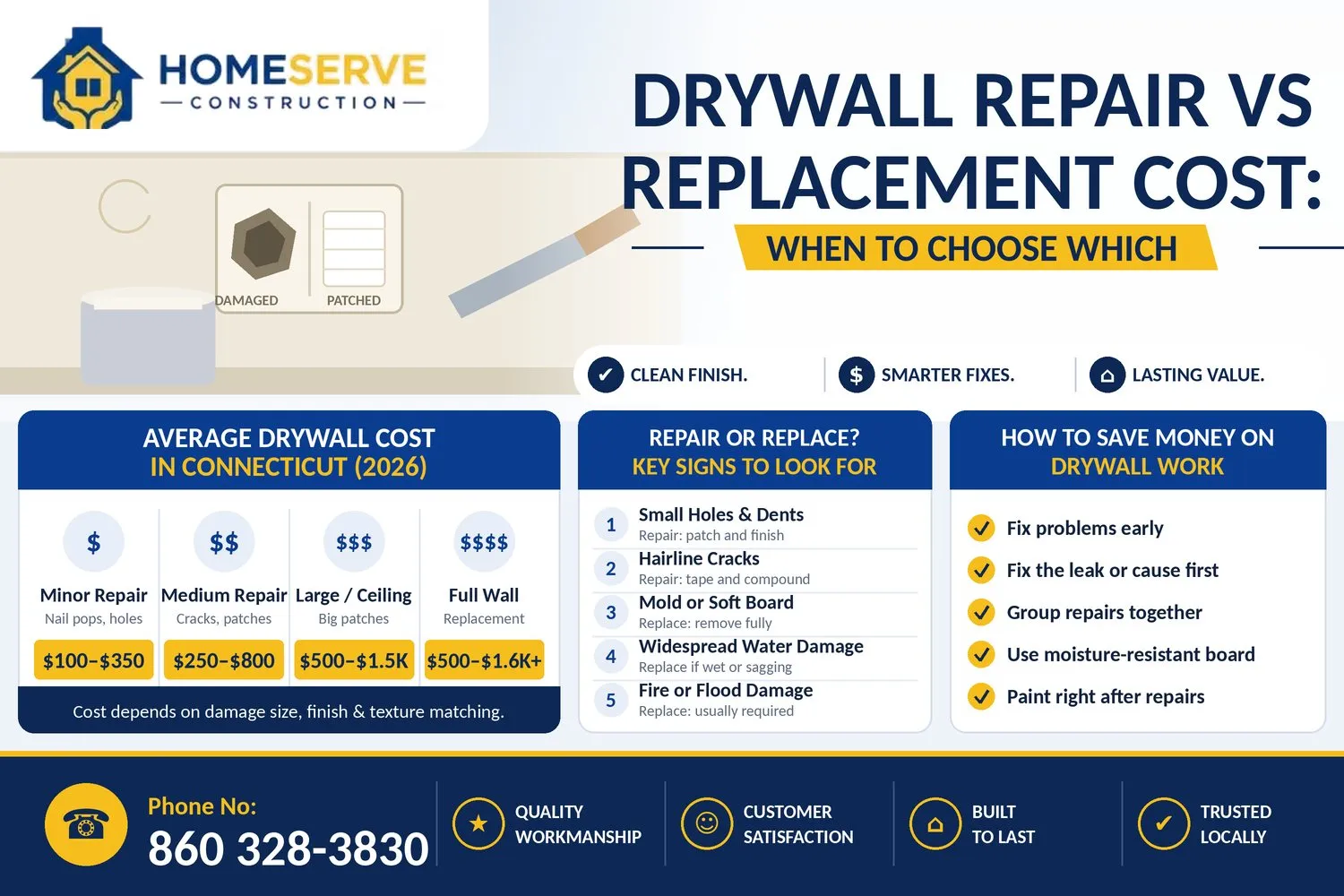
- Patching small holes and cracks (see our guide to drywall repair vs replacement)
- Touch-up and small interior painting jobs
- Minor carpentry such as trim, shelving, and door repairs
- Caulking, weather stripping, and routine maintenance such as cleaning gutters
A handyman is a good fit when the job is small, fits into a day or two, involves no wall removal or structural change, and does not need a permit. Our team offers handyman services for exactly these kinds of jobs.
3. What a general contractor does
A general contractor runs the whole project. Instead of you finding and scheduling each tradesperson, the general contractor plans the work, hires and coordinates subcontractors, orders materials, handles permits and inspections, and is the single person accountable for the result.
This matters because a remodel is a chain of steps that have to happen in the right order: demolition, framing, electrical, plumbing, drywall, finishes, and paint. One missed handoff delays everything after it. Projects that usually call for a general contractor include:
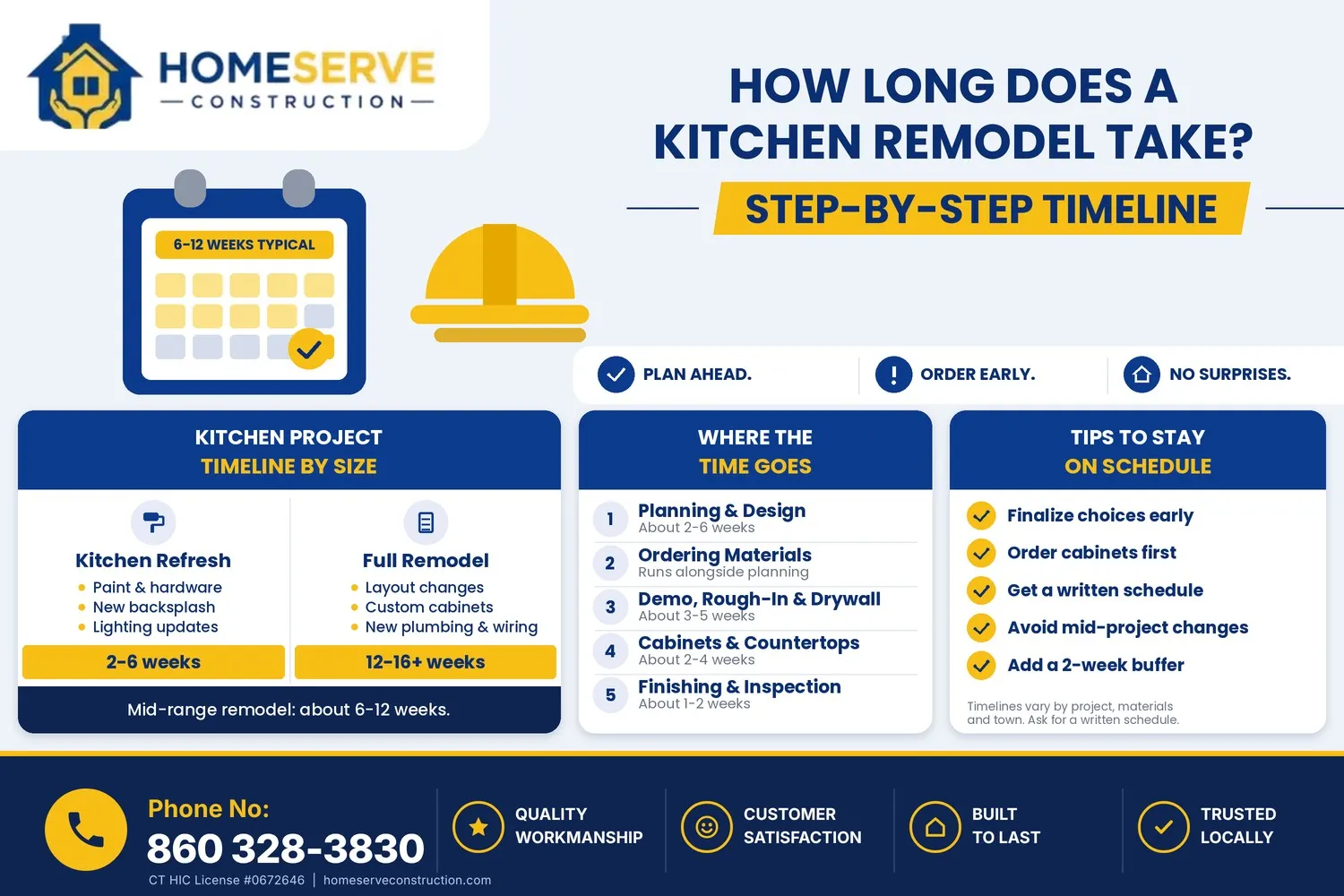
- A kitchen remodel (see kitchen remodeling cost in Connecticut)
- A full bathroom remodel (see bathroom remodeling cost in Connecticut)
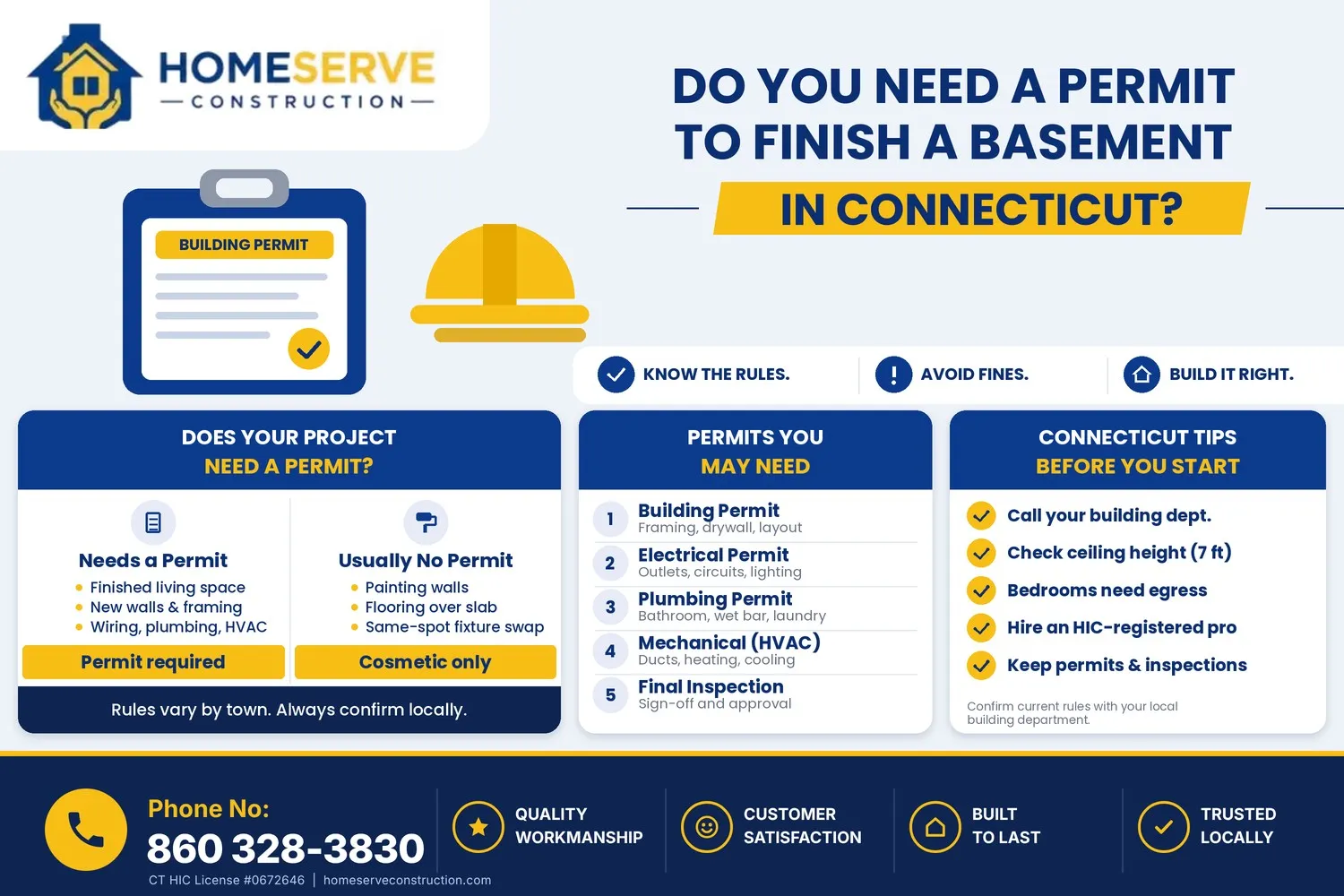
- Basement finishing (see basement finishing cost in Connecticut)
- Deck construction (see deck cost in Connecticut)
- Removing or moving walls, and home additions
One thing to know about Connecticut: the state does not issue a single “general contractor license.” Contractors who do home improvement work register with the Department of Consumer Protection (DCP) as home improvement contractors.
4. How Connecticut regulates both
The rules matter here because they apply to a handyman just as much as to a large remodeling company.
Registration applies to handymen too
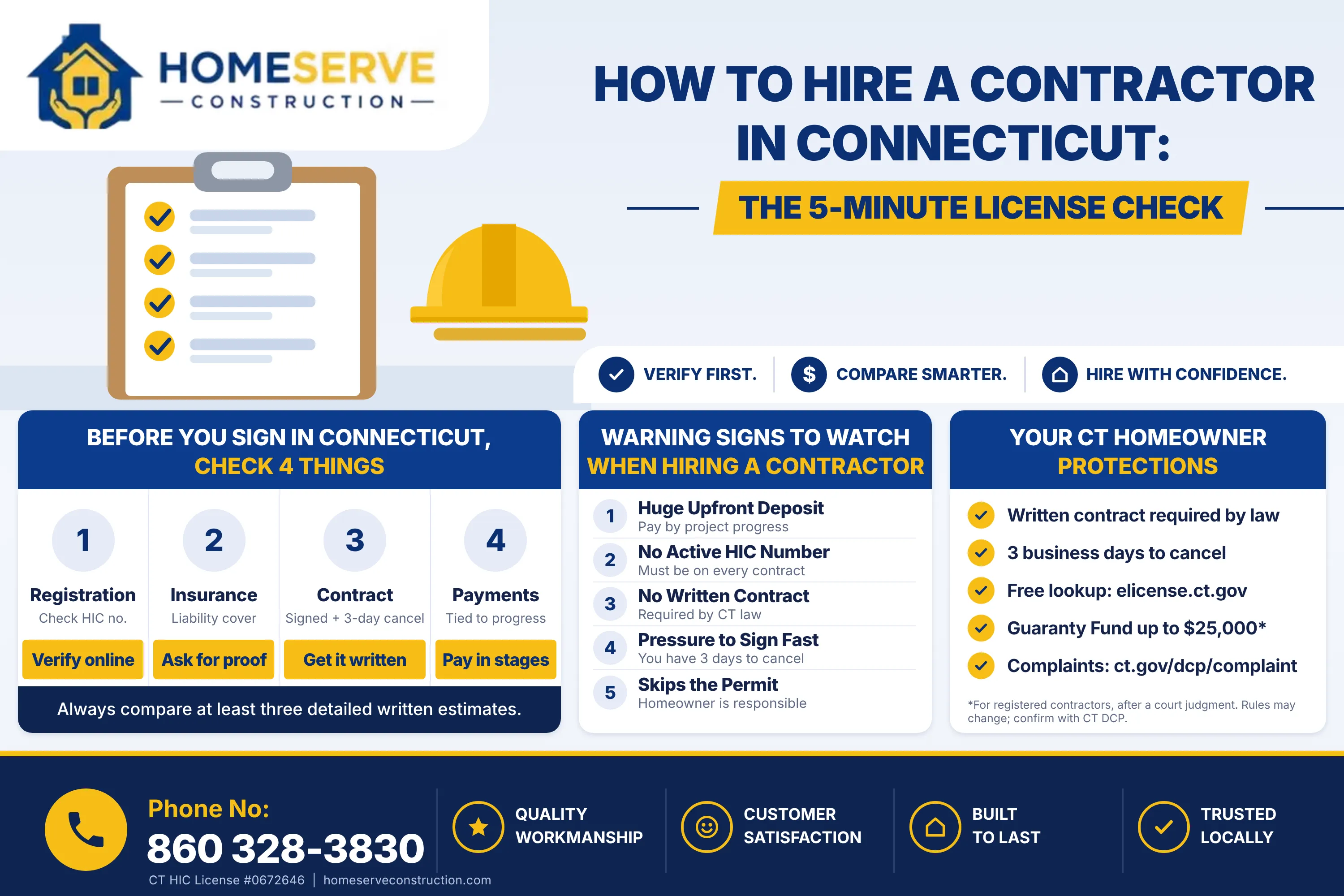
Connecticut’s registration system is for people who do paid home improvement work, and it does not create a separate “handyman” category. Whatever the business calls itself, ask for the HIC registration number and look it up for free at elicense.ct.gov. If someone tells you they do not need one, check with DCP before you hire.
Electrical, plumbing, and HVAC need a trade license
DCP notes that skilled trade work such as electrical, plumbing, and HVAC will likely require a more specific license involving additional training and certification. An HIC registration does not cover it. If a handyman or contractor offers to do this work, ask who holds the license and verify it in the same state lookup.
Permits are still your responsibility
Many projects need a building permit from your town, plus separate trade permits for electrical, plumbing, or heating and cooling work. Either you or the contractor can apply, but the state is clear that having the right permit is ultimately the homeowner’s responsibility. Small cosmetic jobs often do not need one, while remodels usually do.
Contracts and insurance apply to small jobs too
DCP requires a written, signed, and dated contract for home improvement jobs, with a three-business-day right to cancel. Registered contractors must carry at least $20,000 in general liability insurance, which is a minimum, so ask for a certificate that fits the size of your job.
For a full walkthrough of checking a license and reading a contract, see our guide: How to Hire a Contractor in Connecticut.
5. A simple way to decide
Hire a handyman when:
- The job is small and can be finished in a few hours or a couple of days
- No walls are being removed and nothing structural changes
- No permit is required, and no electrical, plumbing, or gas work is involved
- You are fixing, adjusting, or assembling, not rebuilding
Hire a general contractor when:
- Several trades have to work in sequence
- You are remodeling a kitchen, bathroom, or basement, or building a deck
- A wall is coming out, or the layout is changing
- Permits and inspections are required
- You want one written schedule and one person accountable for the result
Hire a licensed specialist when:
- You need new circuits, panel work, or electrical wiring changes
- Pipes are being moved or gas lines are involved
- A heating or cooling system is being installed or replaced
6. Mistakes to avoid
- Using a handyman for a remodel. Nobody coordinates the trades, so gaps, delays, and finger-pointing are common.
- Splitting a big job into small “handyman” pieces to save money. It often backfires: permits get missed, and no one is accountable for how the pieces fit together.
- Skipping the written contract because it is “just a small job.” The scope, price, and timeline should be on paper every time.
- Ignoring insurance. Coverage built for small jobs may not fit a large project, so ask for a certificate that matches the work.
- Choosing on price alone. Compare scope and materials line by line, not just the bottom number.
Smaller repairs are typically quoted per task or by the hour, while remodels are quoted as a project with a written scope, so do not compare the two directly. For a sense of project budgets, see our average price of a kitchen remodel guide.
Frequently asked questions
Do handymen need a license in Connecticut?
There is no separate handyman license, but paid home improvement work generally requires an HIC registration through DCP, and electrical, plumbing, and HVAC work requires a trade license. Verify both at elicense.ct.gov.
Can a handyman do electrical or plumbing work?
Only with the proper Connecticut trade license for that work. A home improvement registration alone is not enough, so ask to see the license number and look it up.
Is a general contractor more expensive than a handyman?
For one small repair, a handyman is usually the simpler and cheaper choice. For a project with several trades, a general contractor’s coordination often prevents costly mistakes and delays.
Can I hire a handyman for a kitchen or bathroom remodel?
A handyman can help with cosmetic updates. A full remodel involves multiple trades, permits, and inspections, which is the job of a general contractor working with licensed specialists.
Can one company do both?
Yes. Many contractors handle small repairs and full remodels. Homeserve Construction does both, so you do not need to decide alone.
Not sure which one you need? Ask Homeserve Construction
Homeserve Construction is a West Hartford, CT contractor that handles handyman services for repairs and small jobs, as well as full remodels from kitchens and bathrooms to basements and decks. We are insured and hold CT HIC License #0672646, and we encourage you to verify it at elicense.ct.gov.
Tell us about your project and we will help you work out the right scope. See our recent work and what customers say about us, then request a free, no-obligation estimate or call (860) 328-3830. We respond within 24 hours.