

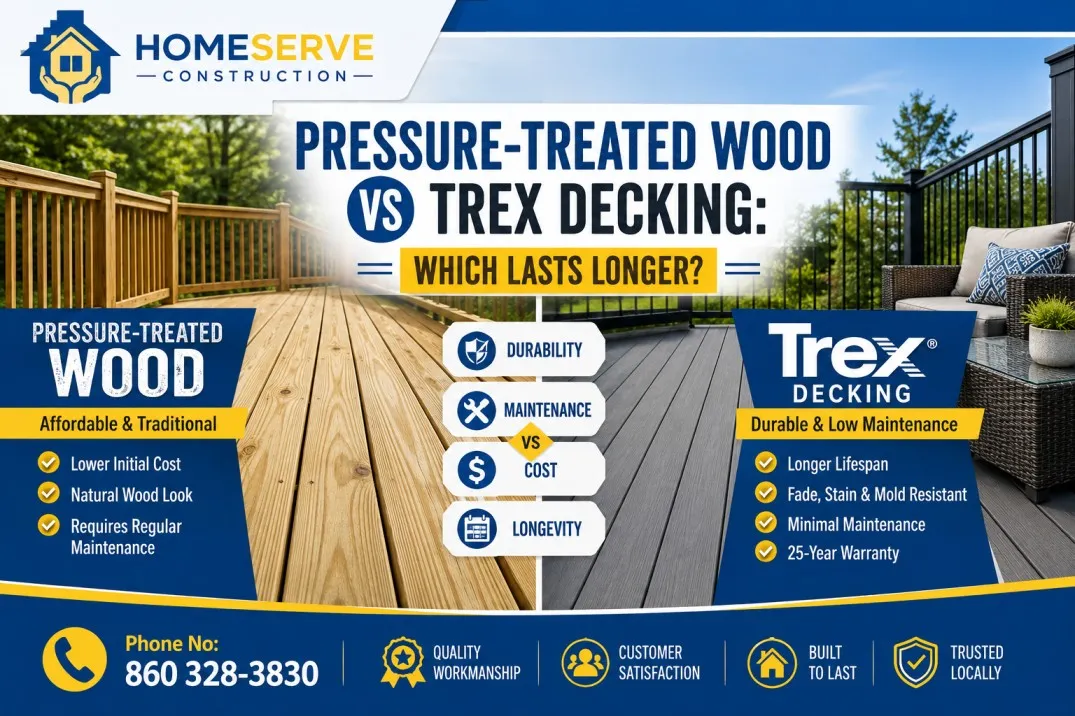
Pressure-Treated Wood vs Trex Decking: Which Lasts Longer?
One of the best choices that one can make in the home is a deck. It puts ease, beauty, and true worth in your property. Before anything else, however, before you start building, there’s one key question to answer: What is the right decking material for your deck? You only have to walk into any home improvement shop. This is where the majority of the homeowners become stuck, even before the project.
The discussion currently in the decking is the one between pressure-treated wood vs Trex decking. These two materials in the market for different reasons and differ significantly in cost, durability, and maintenance. Established in 1990, the North American Deck and Railing Association reports that in the U.S., there are more than 50 million decks that require replacement or repair today, with most of them having the incorrect choice of material when first built.
This guide provides an easy, straightforward comparison of pressure-treated wood vs composite decking that Connecticut homeowners commonly consider, helping you choose the right option for your home, budget, and long-term needs. No confusing, just honest, straightforward information. And when you are ready to construct, Homeserve Construction can help you get your deck constructed correctly.
What Is Pressure-Treated Wood Decking?
Pressure-treated wood is ordinary timber with special chemicals to protect it from rot, moisture, and insect damage, including termites. The most common treatment used today is Alkaline Copper Quaternary (ACQ). Unlike older treatments that contained arsenic, ACQ is a safer option while still providing long-lasting protection for outdoor projects. It has been the top choice for deck building across the country for decades because it works, it’s tough, and it gets the job done.
It comes in different treatment grades, UC4B for ground-level decks and UC3B for standard above-ground boards. Using the wrong grade can lead to early and unnecessary repair costs. This is why it always helps to work with experienced deck builders, West Hartford, CT, homeowners trust, who know exactly which decking materials and installation methods suit your project best.
The biggest reason homeowners love it is the price, just $1.50 to $3.00 per linear foot, and you can find it at any home improvement store. The downside is maintenance. Every 1 to 3 years, you must seal or stain it before it begins to warp, crack, and fade. It is cheap initially but needs routine maintenance to keep it in good condition.
What Is Trex Decking?
Trex decking is a composite material made from 95% recycled materials, including reclaimed wood fibers and recycled plastic, which are combined to create strong, long-lasting deck boards.Trex is a brand name, but it has been so popular that now most homeowners are using it to refer to composite decking overall. It was established in 1996 and is currently the largest supplier of composite decking in the world.
The difference with Trex is that it does not rot, splinter, or fade. It is also moisture-resistant and is not stained or sealed in order to preserve the color of the print over a long period of years. It is also available in a range of colors and finishes that very closely resemble the appearance of actual wood and provide that conventional deck look without the current requirement of natural wood.
Trex boards cost between $8 to $20 per linear foot, higher than pressure-treated wood upfront. But with almost zero maintenance required and a 25-year fade and stain warranty, many homeowners save more money over time. When comparing pressure-treated wood vs Trex decking, that higher price starts making a lot more sense once you think long term.
Initial Cost Comparison: Which Option Fits Your Budget?
When making a deck, the initial inquiry that all owners of a home will have is how much it will cost. That’s completely fair. One of the largest determining attributes of selecting between pressure-treated wood vs Trex decking is the cost. Pressure-treated wood would cost between one and a half and three dollars per lineal foot, while Trex decking costs between 8 and 20 dollars per lineal foot, a considerable difference, particularly when one is doing large jobs.
As part of this deck material comparison, CT, here’s a quick cost breakdown to help you compare both decking options:
- Pressure-treated wood material Cost: $1.50 to 3.00 per linear foot So available and cheap to the homeowner with a tight budget.
- Trex Decking Cost: The Trex Decking material costs between 8 and 20 $ per linear foot, more expensive initially, but constructed to be in use over a few decades with minimal maintenance costs.
- Installation Cost (Both): $5 to $10 per square foot. Labor costs remain similar for both materials, regardless of which you choose.
- Pressure Treated Maintenance Cost: $200 to $500 after every 2-3 years. Sealing and staining are necessary to avoid warping and cracking.
- Trex Maintenance Cost: Since it is a simple clean (or two) a year, it looks almost like the new model.
- 300 sq ft Deck Pressure Treated Total: $3,000-6000 A fairly affordable starting point, however, anticipates more maintenance costs in the long run.
- 300 sq ft Deck Trex Total: $9,000 to $18,000. A bigger investment upfront that pays off significantly in the long run.
The price is only part of the story. Pressure-treated wood may look cheaper today, but maintenance costs stack up quickly over the years. At Homeserve Construction, we help homeowners look at not just today’s price, but what you’ll actually spend over the next 10 to 20 years, so you make a decision that truly makes financial sense.
Also Know About: Average Price of a Kitchen Remodel: Expert Cost Insights
Pressure-treated wood vs Trex decking: Side-by-Side Comparison.
In pressure-treated wood vs Trex decking, one should know that both are equally popular decking materials, but builds them with a lot of different designs. Their variations are in prices, durability, service, physical look, and their value in the long run. This comparison also helps homeowners searching for pressure-treated wood vs composite decking in Connecticut choose the right material based on their budget, maintenance preferences, and local weather conditions.
1. Cost
Treated wood is much cheaper initially, around a dollar and a half to three dollars per linear foot, than engineered wood, and it is a solution to a tight budget when it comes to the homeowner. It is readily accessible, and sourcing can be done without any special ordering or waiting at any local home improvement store.
Understanding the composite decking pros and cons for Connecticut homeowners to consider is important. While Trex decking costs between $8 and $20 per linear foot upfront, its low maintenance and long lifespan can save money over time.
2. Durability
Pressure-treated wood is a tough material, yet it is a natural material that responds to temperature, moisture, and changing weather over time. Lack of proper maintenance can cause it to bend, break, and smash, particularly where the rainfall is very high or in places where it is exceptionally hot.
Trex decking is also designed in such a way that it can withstand moisture, UV, and foot traffic without any additional input. It is more heavily made compared to natural wood, which is left in the natural weather for many years.
3. Maintenance
When using pressure-treated wood, it is important to seal or stain it every 1-3 years to prevent cracking, fading, and drying up in direct sunlight. The failure to complete a single maintenance cycle may result in, which are expensive and time-consuming and cost-impacting.
The Trex decking is virtually free of maintenance, except for a simple clean with soap and water one or two times annually. This would make it a lot more convenient for busy people who are not ready to spend their Saturdays taking care of their deck.
4. Appearance
Pressure-treated wood looks natural with a traditional appearance and texture like real wood, which most home owners feel natural and cozy. But, unless it is stained frequently, it will grow light gray in color and appear old-fashioned within several years.
Trex decking also has an extensive color and wood-grain finish variety, which is aimed at remaining the same and maintaining its appearance over decades. The current Trex products are a long way from resembling the natural beauty of the real wood.
5. Installation
Pressure-treated wood is not new, and the use of simple carpentry tools is acceptable and can be installed by most contractors at their Decision. It is easily drilled, cut, and shaped onsite, which provides the builders with increased flexibility during installation.
Trex deck installation in Connecticut requires precise board spacing, hidden fastener systems, and professional installation techniques to ensure long-lasting performance and a clean, finished appearance. According to their labor costs, both materials are similar, yet Trex requires some extra attention to detail in order to yield the most results.
6. Safety and Comfort
Wood under pressure treatment may develop splits as it dries out, which may be a true fear in families with young children or pets that may have frequent use on the deck. It also takes the heat of the sun, and it is very hot to walk on foot in the summer afternoon.
Trex decking is splinter-free with a smooth surface that remains comfortable to the feet over its entire life span and does not need sanding or refinishing. also be considered a light colour choice since this helps control surface temperature, making the deck cooler during hot sunny days.
Also Explore: Basement Finishing Cost in Connecticut: 2026 Price Guide
Expert Tips Before Choosing Any Decking Material
Choosing the best decking material Connecticut homeowners can rely on is not only about cost or appearance but also about making a smart long-term investment that suits your home’s needs and local climate. The following are professional tips that will save you money and a lot of time in the future, before you finalize anything.
- Consider Your Local Climate: In case you are in an area with high rainfall, humidity, or high or low temperature differences, your decking material must be able to withstand such factors without rusting. Not all materials will act the same in all climates; the local climatic conditions are among the initial filters.
- Be Honest About Maintenance: Other materials are supposed to be sealed, stained, and sanded at least once every two years, and assuming that is a lot of work, you need to consider that in your decision. A low-maintenance deck can be a more expensive choice, but it can save you a great deal of time and effort over the years.
- Always Check the Warranty: Having the correct warranty lets you know the amount of trust that the producer places in its own. Before making a decision, carefully read the details to understand exactly what is covered and what is not.
- Understand the Installation Process: Some decking materials can be easily installed, and there are those that need special tools or professional skills to install effectively. By finding out what the installation will require in advance, you would save on budgeting correctly and not making any travel expenses.
- Always Work With a Trusted Builder: The quality of your deck depends not only on the materials used but also on who installs it. Hiring an experienced and reputable deck builder ensures your deck is built safely, correctly, and designed to last for many years.
Also Explore: How to Install a Basement Window | Expert Guide
Which One Is Right for Your Home?
If you’re comparing Trex decking vs wood deck CT and are on a tight budget, pressure-treated wood may be the better option, especially if you’re comfortable with regular maintenance such as sealing and staining every few years. It provides you with a natural wood appearance and combination at a very low initial price. With most short-term projects or smaller areas of outdoor space, it is difficult to find a better solution.
And, as far as keeping it low maintenance and long-lasting with the appearance of a decking that does not require good care regularly, but rather once or twice a month, then Trex decking would be a more intelligent choice in the long term. It is expensive in the short run, but it will save you on repairs and maintenance in the long run. To busy house owners, families with kids, or those in harsh weather conditions, Trex just makes common sense.
If you’re comparing a composite vs wood deck West Hartford, choosing the right material depends on your budget, maintenance preferences, and long-term goals. And therein lies Homeserve Construction. Our skilled workers are here to assist homeowners in making the correct decisions on decking as per their budget, lifestyle, and the individual project requirements to ensure that you construct it once and enjoy it throughout the years.
Why Homeowners Trust Homeserve Construction for Deck Building Projects
A great deck depends on both the materials you use and the builder who installs it. But at Homeserve Construction, we do not just begin to build. We combine the first sitting, we get to know your budget and your target, and help you in selecting the appropriate decking material in relation to your home and our lives.
Both Trex decking and pressure treated wood, we have hands-on experience with them and know where each type works best. We will not advise you on what is most convenient or costly for us to do. We are contracted to ensure that all the money spent on your deck is a good, long-term investment.
Rotating around the very first board to the last finishing, each deck we make is made with care and attention. We do not cut corners since a deck is more expensive to repair in the future. When constructs your deck, we construct it as if it were our own.
Conclusion
When it comes to deciding between the types of pressure-treated wood vs Trex decking, at the end of the day, it depends on your financial capacity, your lifestyle, and the amount of work you are looking to perform with regard to maintenance. Both are good options, but the correct one is based on your circumstances and long-term objectives.
Preference is given to the use of pressure-treated wood, in case you want something that performs the task well and is affordable. Trex decking is a more cost-efficient investment in the event that you need highly durable and low-maintenance decking. Anyhow, saving you time, money, and lots of frustration in the future, it depends on what you know before you start building.
Homeserve Construction is on call when you are planning to construct. In picking the correct material to use and the actual construction of the deck designed to last, we bring in the experience and craftsmanship needed for your home. Get in touch with us today, and let’s get started.
Ready to create the perfect outdoor living space? Contact Homeserve Construction today for a free consultation and estimate for your new deck.